ALTiDUX Get notified

Road and mountains · iPhone and Apple Watch

Run your perfect race.

ALTiDUX builds a training plan for your race. Then, on race day, it guides you on your watch, kilometre by kilometre: when to hold back, when to push, and when you are exactly right. On flat city streets and on steep mountain trails.

In testing now. Coming to the App Store.

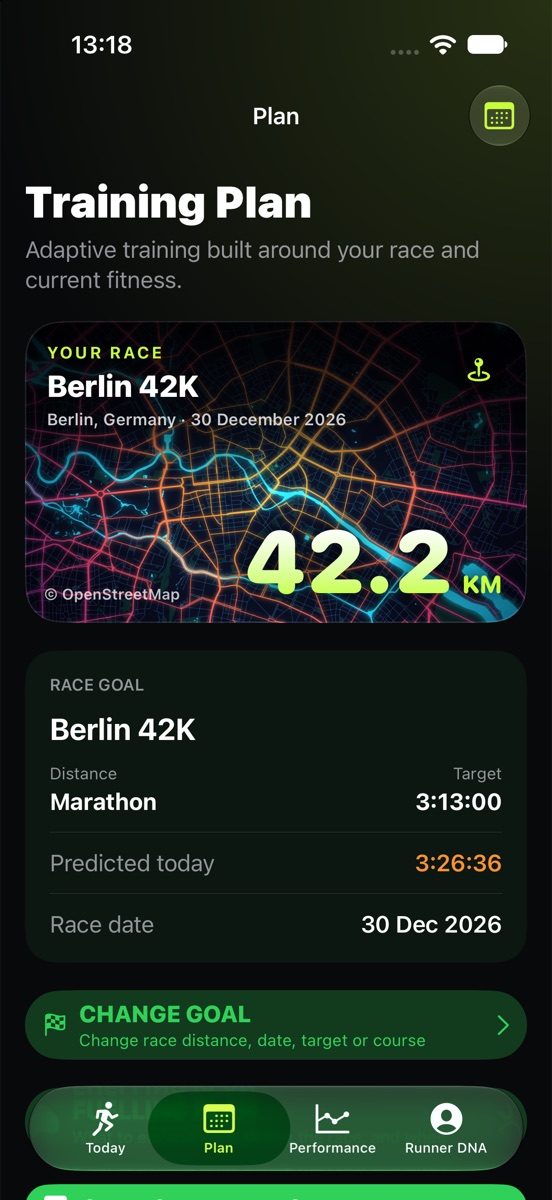
A road race in the app: a marathon on a glowing map of its city with the distance, 42.2 km, the target time and today's predicted time.
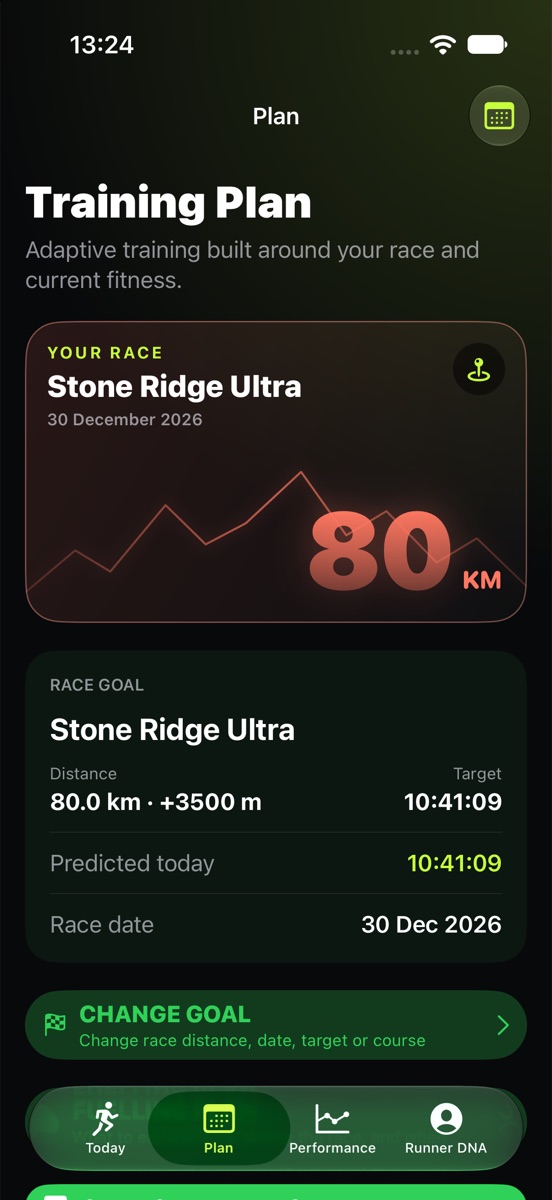
A mountain race in the app: an 80 km ultra with 3500 metres of climbing, drawn over a ridge line, with its target time.
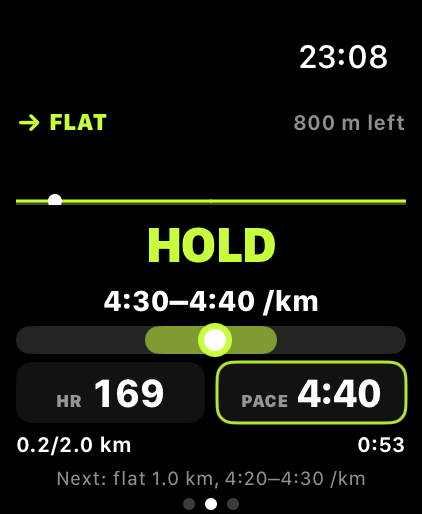
The race pilot on an Apple Watch: the word HOLD, the target pace range 4:30 to 4:40 per kilometre, heart rate and current pace.

How it works

Three steps, from today to the finish line.

  1. 1

    Tell it your race

    Pick the distance and the date. Have the course file from the organiser (a GPX)? Load it. No file? Type the distance and the total climb. That is enough for a plan.

  2. 2

    Train with a plan made for you

    Every week says what it is for. Every workout says how to run it. The plan starts from what you run now, not from what an average runner runs.

  3. 3

    Race with a pilot on your wrist

    Your watch knows the course and your plan. One big word tells you what to do right now: HOLD, PUSH or EASE OFF.

The race pilot

Most races are lost in the first kilometres.

You feel great, the crowd carries you, and you start too fast. You pay for it later. The pilot is there to stop exactly that.

  • One word, readable at a glance. HOLD when you are on target, PUSH when you are slower than planned, EASE OFF when you are too fast.
  • A range, not a single number. Nobody runs to the second. You get a pace range and see where you are inside it.
  • It knows the course. On the flat it guides you by pace. On a climb, pace means little, so it guides you by heart rate, and tells you when walking is the faster choice.
  • It tells you what comes next. “Next: climb, 1.2 km” appears before you get there.
  • Reminders to eat and drink in longer races, so you do not remember at kilometre 30 that you forgot.
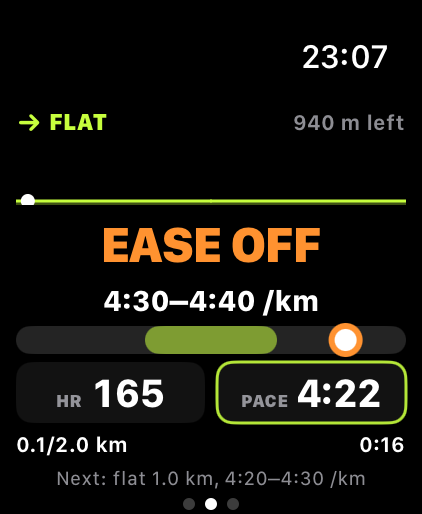
The pilot showing EASE OFF: the runner's pace of 4:22 is faster than the target range of 4:30 to 4:40.
Too fast: ease off
The pilot showing HOLD: the runner is inside the target range.
On target: hold

Your training plan

A plan that starts where you are.

A good plan does not open at full load. It lets you come into the rhythm, builds step by step, gives you easier weeks to absorb the work, and brings you to the start line fresh.

  • Built from your running. How much you run in a week and your longest run decide where the plan begins. If you connect Apple Health, your real runs keep it honest.
  • Every week has a name and a reason. “Base”, “Build”, “Taper”: one sentence tells you what the week is for.
  • Every workout explains itself. What to run, how fast, why it is in the plan and how to pace it.
  • Life happens. Drag a workout to another day. Skip one. Ill or injured? Tell the app and the plan adapts instead of asking you to catch up.
  • Treadmill day? One switch turns the workout into treadmill speeds and inclines.
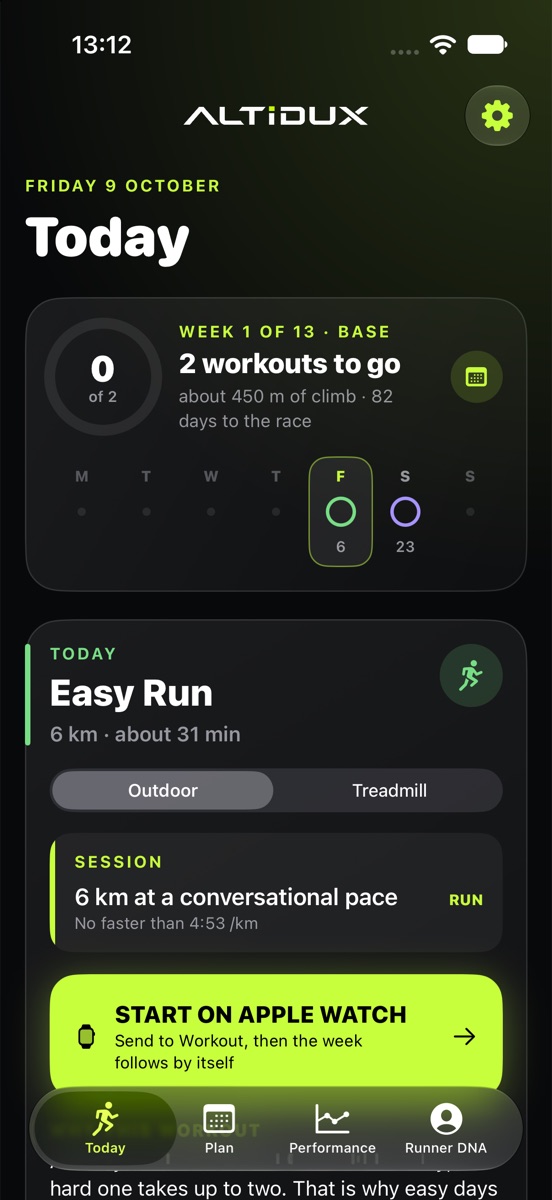
The Today screen: the week at a glance with its seven days, and today's easy run with a button to start it on Apple Watch.
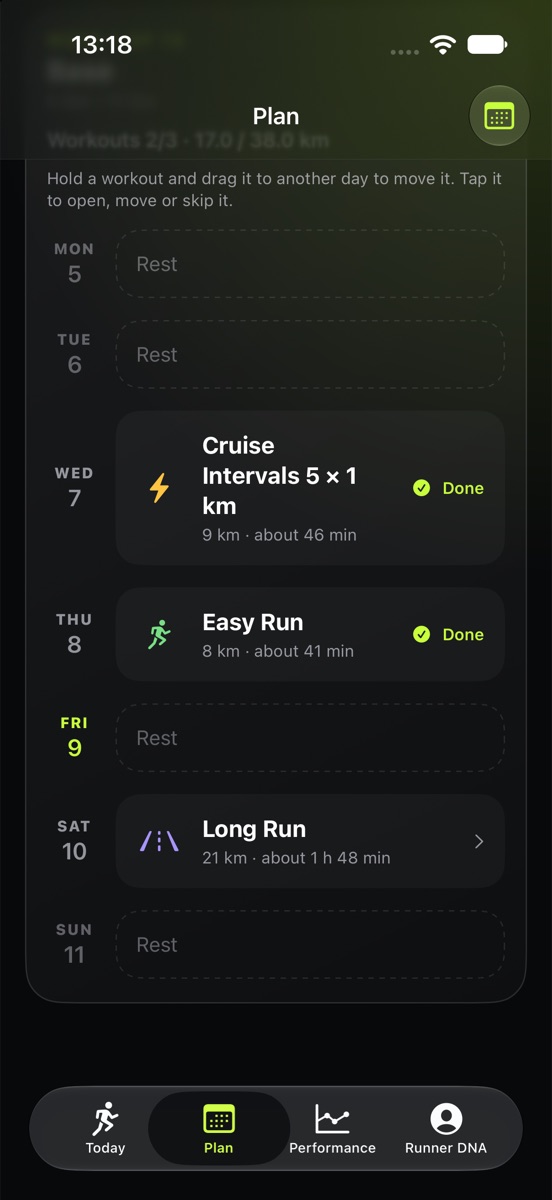
A week of the plan: rest days, interval session and easy run marked done, long run still to come.

One app, two worlds

Flat city streets. Steep mountain trails.

A flat 10 km and an 80 km mountain race ask for different training and a different race plan. ALTiDUX reads the course and prepares you for the one you are actually running. Many runners do both; so does the app.

On the road

5 km to the marathon

  • Pace is the guide. Target paces come from your current form, not from a table.
  • Even from the first kilometre. The pilot holds you back early, where road races are lost.
  • A finish time you can believe, worked out from your recent runs and races.
  • Your race on a map of its city, drawn in lights.

In the mountains

Trail races and ultras

  • Heart rate is the guide on climbs. Pace means little uphill, and the pilot says when walking is faster.
  • Long runs by time, each with the right amount of climbing, and a climbing target for the week.
  • Hill sessions and back-to-back long days, as mountain races demand.
  • It learns what hills cost you from the races you have finished.
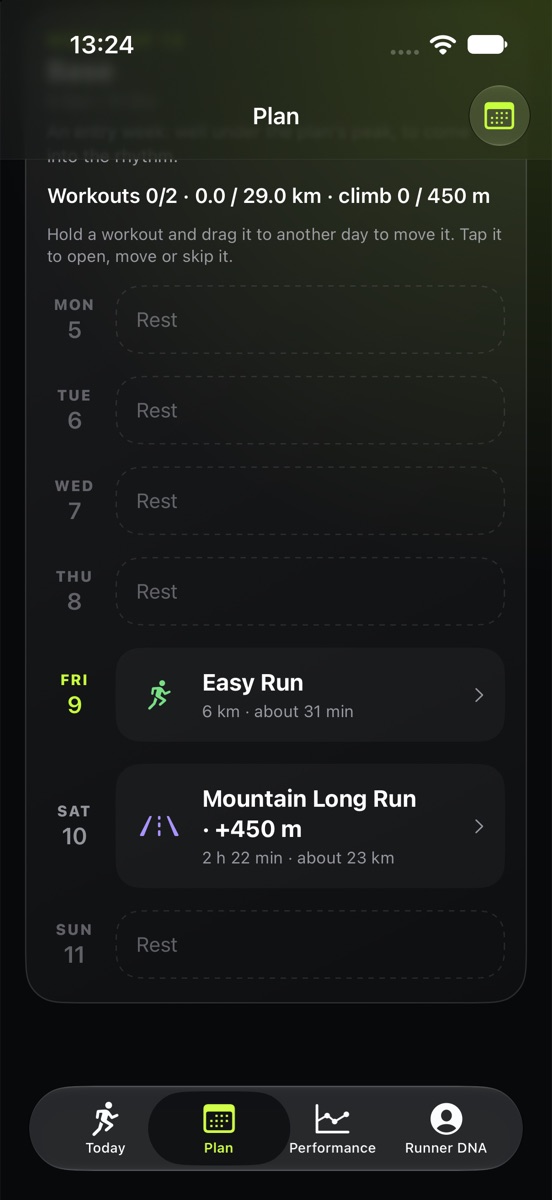
A week of a mountain plan: an easy run and a mountain long run of 2 hours 22 minutes with 450 metres of climbing.

A week with climbing in it

Training for a hilly race? The week shows how many metres to climb, and the long run is planned by time, not distance.

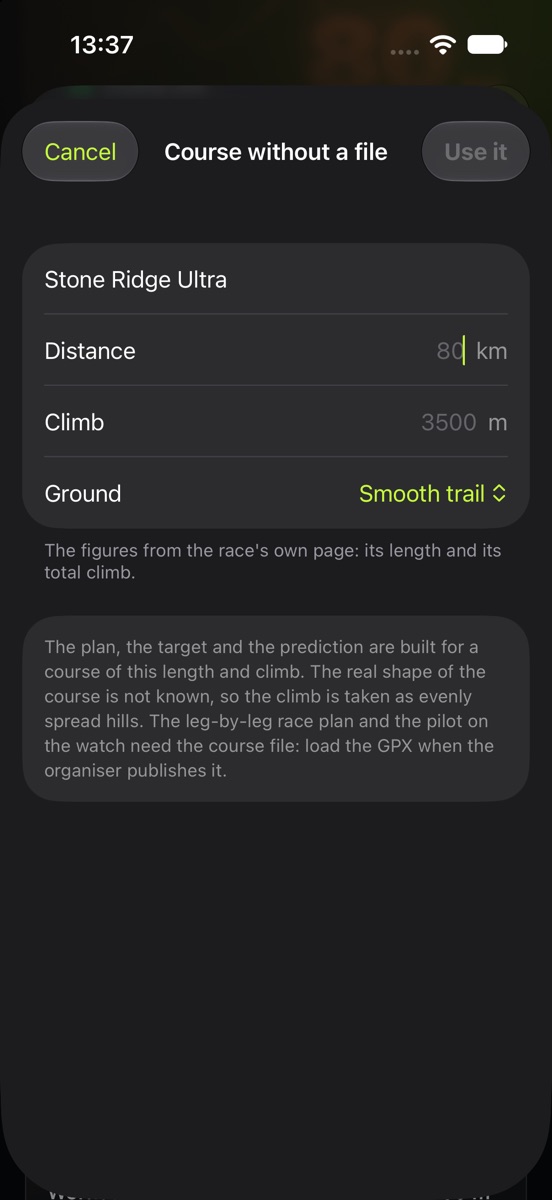
Entering a race without a course file: its name, distance 80 km, climb 3500 m, and the ground: smooth trail.

No course file? No problem

Load the organiser's GPX, or just type the distance and the total climb. The plan and the target time are built for a course like that. The pilot on the watch needs the real file; add it when the organiser publishes it.

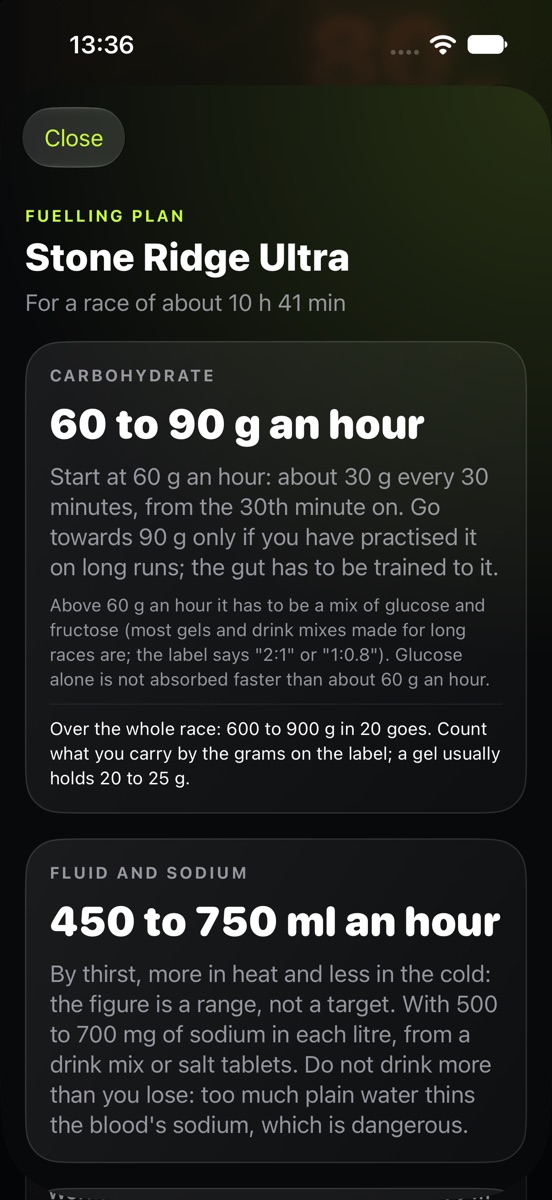
The fuelling plan for an 80 km mountain race: 60 to 90 grams of carbohydrate an hour and 450 to 750 millilitres of fluid an hour.

Eating and drinking

For races over about 75 minutes: how much carbohydrate and fluid an hour, and when. A starting point to practise on your long runs.

After every run

See your run, not a spreadsheet.

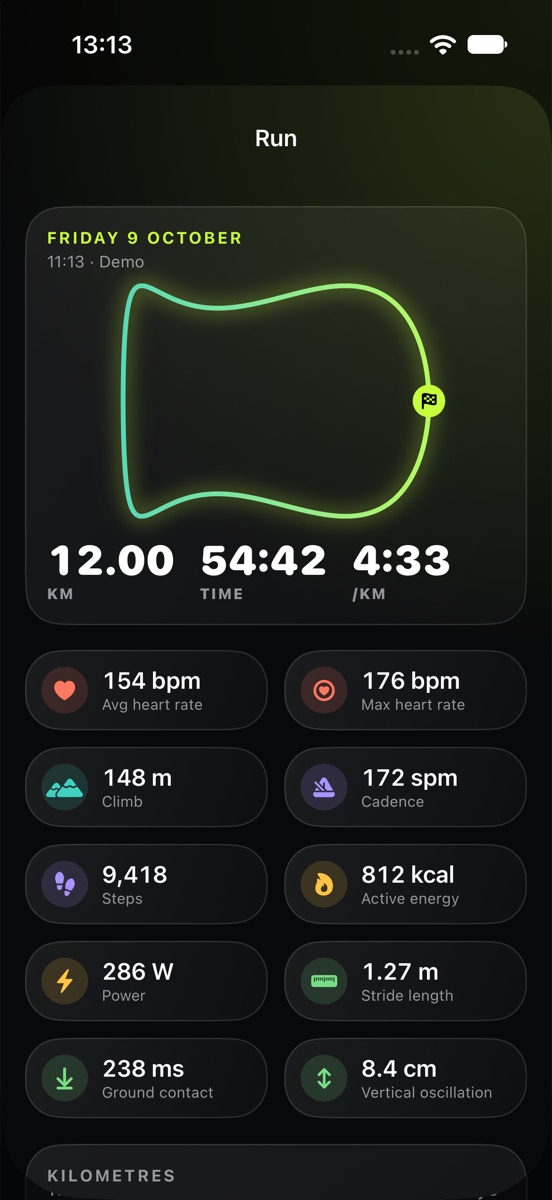
Your route, your numbers and every kilometre, on one screen you can read in ten seconds.

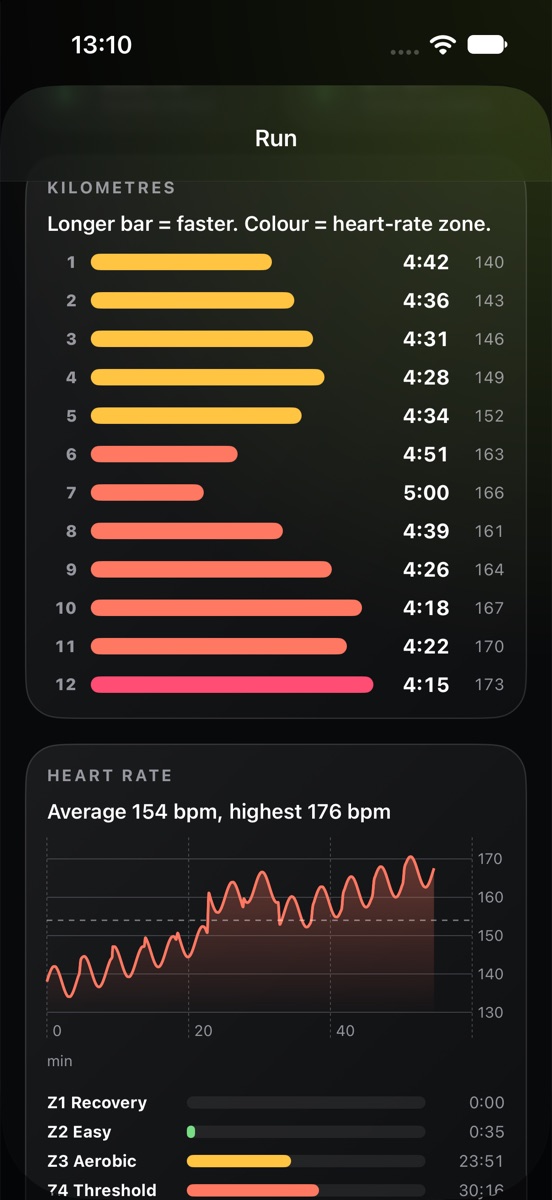
  • Every kilometre as a bar. Longer means faster. The colour shows how hard your heart was working.
  • Heart rate, height, cadence. Clear charts, and how long you spent in each heart-rate zone.
  • Details when your watch records them: steps, energy, power, stride length, ground contact.
  • It learns from your races. Add races you have finished and the app works out what hills cost you, and how well you hold your speed over long distances.
A run: its route as a glowing line, 12.00 km in 54:42 at 4:33 per kilometre, and tiles with heart rate, climb, cadence, steps and more.
The same run by kilometre: bars coloured by heart-rate zone with pace and heart rate, and a heart-rate chart.

New to running?

Running words, in plain words.

Training plans are full of jargon. Here is all of it you need. The app explains each workout the same way.

Easy run
Slow enough to chat. Most of your running should be this. It builds your engine without wearing you out.
Long run
The longest run of your week, usually at the weekend. It teaches your body and your head to keep going.
Intervals
Short, fast pieces with rests between, for example 5 × 1 km. They make you faster.
Tempo
“Comfortably hard” for a longer stretch. It teaches you to hold a strong pace.
Strides
Twenty seconds of fast, relaxed running after an easy run. They keep your legs quick.
Hill repeats
Run up a hill hard, jog back down, repeat. Strength training in disguise.
Rest day
No running. The fitness comes while you recover, so a rest day is part of the plan, not a gap in it.
Taper
The last one to three weeks before the race: less running, so you arrive fresh instead of tired.
Pace
How many minutes one kilometre takes you. “5:30” means five and a half minutes per kilometre.
Heart-rate zone
How hard your heart works, in five steps from very easy to all-out.
GPX
A small file with the map of a race course. Many organisers offer it on the race website.
Cadence
How many steps you take in a minute.
No guesswork

Built on what is known, and honest about the rest.

The rules inside ALTiDUX are checked against published research and long-used coaching practice. Where something is our own judgement, we say so in the app.

Building up safely

Weekly distance grows in small steps, with easier weeks in between. Sudden jumps are what the injury studies warn about.

The taper

Before the race the volume comes down step by step while the intensity stays, as the research on tapering found works best.

Hard and easy

A hard session can take up to two days to recover from, so hard days are spread out and easy days stay easy.

Fuel

Carbohydrate and fluid guidance follows the sports-nutrition guidelines used for endurance events, starting from the careful end.

ALTiDUX is a training tool, not medical advice. If you have a health condition or are new to exercise, talk to a doctor first.

Which watch?

Today: iPhone with Apple Watch. Workouts go straight to the Workout app on your watch; the race pilot runs in the ALTiDUX watch app.

Planned: COROS, Suunto and Garmin. We know mountain runners wear them. No dates yet, and we will not promise what we have not built.

Runs recorded with another watch already count: if your watch saves to Apple Health, ALTiDUX reads them.

Questions

Good to know.

Is it for beginners?

Yes. You choose your level, and a beginner's plan starts with easy running only. Every workout says in plain words what to do and why. You do not need to know your “threshold” or any other number to start.

Do I need an Apple Watch?

For the race pilot, yes. The training plan, the race plan and your run history work on the iPhone alone.

I do not have a course file. Can I still use it?

Yes. Enter the distance and the total climb from the race website. You get a plan and a target time for a course like that. The kilometre-by-kilometre race plan and the pilot need the real course file, which you can add later.

Is it only for mountain races?

No. It plans and pilots a flat 5 km as happily as a mountain ultra. The mountain part is simply something most running apps do not do.

What happens if I miss a week?

Tell the app why: illness, injury, travel, work. It works out a sensible way back instead of piling the missed sessions on top of the coming ones.

What does it cost?

The price will be announced before launch.

What about my data?

There is no account to create. Your plan and your runs stay on your phone. The app reads your runs from Apple Health only with your permission. To draw the map of your race's town it asks OpenStreetMap's servers for the streets of that place.

Which languages?

English first. Polish and Czech are next.

Be there at the start.

ALTiDUX is being tested on real runs right now. Leave us a line and we will write once, when it is in the App Store.

Tell me when it is ready

This opens your e-mail app. We use your address for that one message only.